
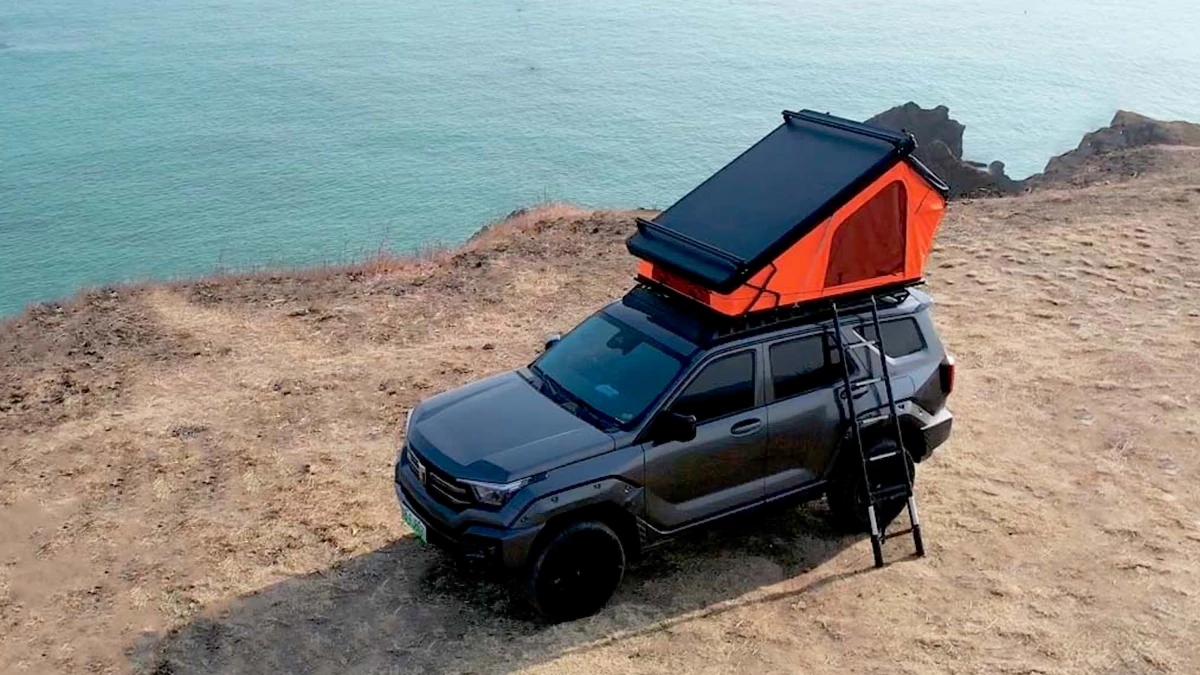
Rooftop tent weight is one of the most important specifications to check before choosing a tent.
A rooftop tent may look ideal in terms of size, shell design and sleeping capacity, but it still needs to match the vehicle and the roof rack or crossbar system supporting it.
Rooftop tents vary significantly in weight depending on their structure, shell material, sleeping capacity, mattress, frame and accessories. Lightweight models may weigh considerably less than large aluminum hard-shell or family-size tents.
Before buying or installing a rooftop tent, always check three things:
- The actual net weight of the rooftop tent
- The vehicle manufacturer’s roof-load information
- The rated capacity of the roof rack, crossbars or platform
The lowest rated part of the complete system should always be treated as the limiting factor.
How Much Does a Rooftop Tent Weigh?
There is no single standard rooftop tent weight.
Depending on the design, many rooftop tents fall somewhere between roughly 40 kg and more than 90 kg. Large models, heavy-duty aluminum structures and tents with more accessories can weigh even more.
The following ranges are general examples only. Always use the actual specifications of the specific rooftop tent you are considering.
| Rooftop Tent Type | Approximate Weight Range | Typical Characteristics |
|---|---|---|
| Lightweight Rooftop Tent | 40–60 kg | Lower total roof weight, compact construction |
| Soft Shell Rooftop Tent | 45–75 kg | Fold-out structure, larger sleeping platform |
| ABS Hard Shell Rooftop Tent | 50–75 kg | Molded shell, streamlined design |
| Aluminum Hard Shell Rooftop Tent | 60–90+ kg | Rigid shell, durable structure |
| Clamshell Rooftop Tent | 55–85+ kg | Fast wedge-style opening |
| Large 3–4 Person Rooftop Tent | 65–90+ kg | Larger mattress and sleeping area |
These figures should be used only as a general comparison because two tents of the same category can still have very different weights.
What Makes a Rooftop Tent Heavy?
Several parts of a rooftop tent contribute to its total weight.
1. Shell Material
Hard-shell tents commonly use aluminum, ABS or other molded structural materials.
Aluminum can provide strong structural performance but may increase total weight depending on panel thickness, frame design and hardware.
ABS shells can offer different weight and styling characteristics, but the final tent weight still depends on the complete structure rather than shell material alone.
2. Tent Size
A larger sleeping platform normally requires:
- More frame material
- More fabric
- A larger mattress
- More hardware
- A larger shell or base
For this reason, a 4-person rooftop tent will usually be heavier than a compact 2-person model.
3. Mattress
The mattress may appear simple, but larger and thicker foam mattresses can add several kilograms to the complete tent.
When comparing tents, check whether the published weight includes the standard mattress.
4. Ladder
Telescopic aluminum ladders are commonly supplied with rooftop tents.
Depending on the design, the ladder may either remain attached to the tent or be transported separately.
Always confirm whether the ladder is included in the published net weight.
5. Frame and Base
The internal frame, baseboard, hinges, mounting rails, gas struts and supporting hardware all contribute to total weight.
A tent designed for heavy-duty use may use stronger structural components than a lightweight tent.
6. Accessories
Optional accessories such as:
- Roof bars
- Solar panels
- Storage systems
- Annex rooms
- Extra mattresses
- Awning brackets
- Internal lighting systems
can increase the total load carried by the vehicle.
Rooftop Tent Weight vs Vehicle Roof Load
The weight of the tent should never be considered separately from the vehicle.
Before installation, check your vehicle owner’s manual or official manufacturer information for roof-load guidance.
You should also check the roof rack or crossbars.
For example, even if a vehicle roof can support a certain load, the crossbars may have a lower rating.
A Simple Way to Think About the System
| Component | What to Check |
|---|---|
| Vehicle Roof | Manufacturer roof-load guidance |
| Roof Rails | Whether they are structural and suitable for carrying a tent |
| Crossbars | Rated dynamic load |
| Platform Rack | Rated load and mounting method |
| Rooftop Tent | Net weight and mounting footprint |
| Accessories | Additional weight carried on the roof |
The safest approach is to treat the lowest rated part of the system as the maximum allowable limit.
Dynamic Load vs Static Load
One of the most common sources of confusion when discussing rooftop tent weight is the difference between dynamic and static load.
Dynamic Roof Load
Dynamic load refers to the load carried while the vehicle is moving.
When driving, the roof system is exposed to:
- Braking forces
- Cornering
- Acceleration
- Road vibration
- Wind
- Uneven terrain
For rooftop tent installation, dynamic load capacity is particularly important.
Static Roof Load
Static load refers to the load supported while the vehicle is parked.
When camping, the system may be supporting:
- The rooftop tent
- Mattress
- Occupants
- Bedding
- Equipment inside the tent
Do not simply assume that a vehicle can support any static load because it carries a lighter load while driving.
Vehicle and rack manufacturers should be consulted for the relevant ratings and limitations.
Does Rooftop Tent Weight Include People?
Usually, when a manufacturer publishes rooftop tent net weight, it refers to the product itself.
It normally does not include:
- Occupants
- Bedding
- Personal equipment
- Optional accessories
- Roof rack weight
This is why you should distinguish between driving load and camping load.
When driving, the vehicle is primarily carrying the tent, rack and related roof-mounted equipment.
When parked, occupants enter the tent and increase the static load.
Is a Lightweight Rooftop Tent Better?
Not necessarily.
A lightweight rooftop tent can provide important advantages, particularly for smaller vehicles or vehicles with more limited roof-load capacity.
Potential benefits include:
- Lower vehicle roof load
- Easier installation and removal
- Less weight added to the vehicle
- Potentially wider vehicle compatibility
- Easier warehouse and logistics handling
However, reducing weight may also affect other design factors.
Depending on the product, a lightweight tent may have:
- A smaller sleeping platform
- A thinner structural system
- Fewer accessories
- A different mattress
- A different shell design
The best tent is not simply the lightest tent. It is the tent that provides the right balance of weight, space, structure and intended use.
What Rooftop Tent Weight Is Right for My Vehicle?
There is no universal answer.
Start with the vehicle rather than the tent.
Step 1: Identify Your Exact Vehicle
Record:
- Manufacturer
- Model
- Model year
- Roof type
Step 2: Check the Roof System
Identify whether the vehicle has:
- Factory roof rails
- Crossbars
- Platform roof rack
- Pickup bed rack
- Canopy rack
Step 3: Check Load Ratings
Confirm the rated capacity of the vehicle roof and rack system.
Step 4: Compare Rooftop Tent Weight
Add together:
- Tent weight
- Rack weight
- Permanently installed accessories
Step 5: Consider Tent Size
Do not choose a tent simply because the weight is acceptable.
Also check:
- Mounting footprint
- Closed dimensions
- Vehicle width
- Rack spacing
- Number of sleepers
Rooftop Tent Weight by User Type
| User / Vehicle Situation | What to Prioritize |
|---|---|
| Small SUV or crossover | Lower tent weight and compact dimensions |
| Large SUV | Balance between sleeping space and total roof load |
| Pickup with bed rack | Rack capacity, tent footprint and center of gravity |
| Family camping | Sleeping size and capacity |
| Overlanding | Weight, low profile, durability and setup speed |
| Frequent installation/removal | Lower weight and easier handling |
| Long-distance touring | Packed profile, weight and aerodynamic design |
Does a Heavier Rooftop Tent Affect Driving?
Adding weight to the roof changes the vehicle’s overall center of gravity.
Depending on the vehicle and tent, drivers may notice changes in:
- Handling
- Cornering
- Braking
- Fuel consumption
- Wind sensitivity
- Overall vehicle height
This makes correct installation and appropriate vehicle matching especially important.
Drive conservatively after installing a rooftop tent and follow all vehicle and rack manufacturer instructions.
How Can Buyers Compare Rooftop Tent Weight?
For distributors, importers and outdoor brands, weight should be included in the product comparison process.
A professional specification sheet should clearly show:
| Specification | Why It Matters |
|---|---|
| Net Weight | Vehicle compatibility |
| Gross Weight | Freight and handling |
| Closed Dimensions | Shipping and vehicle profile |
| Open Dimensions | Sleeping space |
| Packaging Dimensions | Container loading and freight |
| Shell Material | Structure and market positioning |
| Sleeping Capacity | Target customer |
| Mounting Requirements | Installation compatibility |
For wholesale sourcing, packaging weight and dimensions are especially important because they affect transportation and warehouse costs.
Frequently Asked Questions
How heavy is a rooftop tent?
Rooftop tents can range from relatively lightweight models around 40–60 kg to larger hard-shell or family models exceeding 80–90 kg. Always check the exact model specification.
Is 70 kg too heavy for a rooftop tent?
That depends entirely on the vehicle, roof rack and mounting system. A 70 kg rooftop tent may be appropriate for one vehicle and unsuitable for another.
Do roof racks add to the total roof weight?
Yes. The roof rack or crossbars themselves contribute weight and should be considered as part of the total roof-mounted system.
Are hard-shell rooftop tents heavier?
Many hard-shell rooftop tents are heavier than compact soft-shell models because of their rigid shells and structural components, but there are also lightweight hard-shell designs.
How do I know which rooftop tent fits my vehicle?
Check the vehicle make, model, year, roof configuration, rack system, roof-load information, tent weight and mounting dimensions.
Need Help Choosing the Right Rooftop Tent Weight?
Not sure which rooftop tent size or weight is suitable for your vehicle?
Send us your:
- Vehicle make and model
- Model year
- Roof rack or crossbar setup
- Number of sleepers
- Main camping use
We can help you compare suitable rooftop tent sizes, weights and structures for your application.