
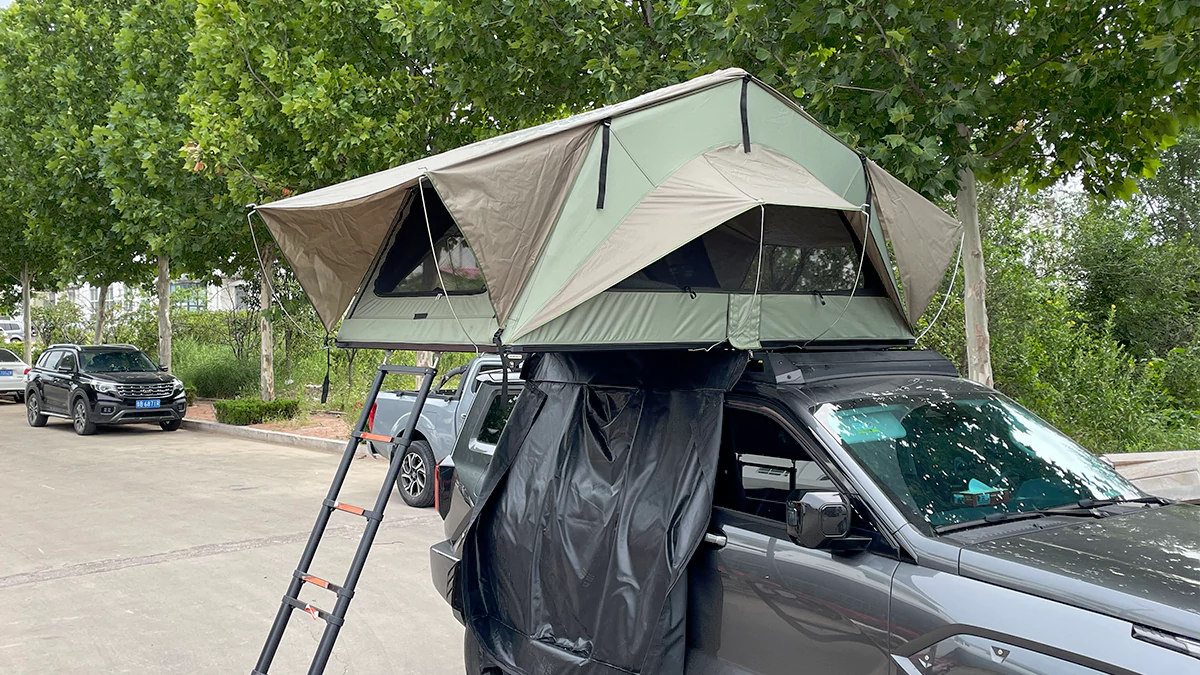
Rooftop tents have become a popular camping option for SUVs, pickup trucks and overlanding vehicles, but they are also a much larger investment than a conventional ground tent.
So, are rooftop tents actually worth it?
For people who camp frequently, travel by vehicle and value faster campsite setup, a rooftop tent can be extremely convenient.
For occasional campers, people with limited vehicle roof capacity or anyone who wants the lowest-cost camping setup, a traditional ground tent may make more sense.
The answer depends on how you travel, how often you camp, your vehicle and what you value most.
Rooftop Tent Pros and Cons at a Glance
| Factor | Rooftop Tent Advantage | Possible Disadvantage |
|---|---|---|
| Setup | Can be quick, especially hard-shell models | Some fold-out models require more steps |
| Sleeping Position | Elevated above the ground | Requires climbing a ladder |
| Mattress | Mattress can remain inside many models | Mattress thickness varies |
| Campsite | No need to find flat tent-sized ground | Vehicle must remain at campsite while tent is open |
| Storage | Tent travels on the vehicle | Requires roof or garage storage when removed |
| Vehicle Use | Excellent for road trips and overlanding | Adds weight and height |
| Weather | Elevated platform avoids ground water | Wind exposure can be higher |
| Cost | Long-term camping system | Higher initial cost than ground tents |
Why Are Rooftop Tents Popular?
The main attraction is convenience.
Instead of unpacking poles, finding flat ground and building a tent from scratch, many rooftop tents can be opened directly from the vehicle.
Hard-shell and clamshell rooftop tents can be particularly quick to deploy.
For people who move between campsites regularly, this can save time.
Advantage 1: Faster Camping Setup
Setup speed depends on the tent type.
Hard Shell Rooftop Tents
Many hard-shell tents use gas struts or assisted-opening systems.
The user normally:
- Releases the shell latches
- Opens the tent
- Extends the ladder
- Arranges bedding if necessary
Soft Shell Rooftop Tents
Soft-shell tents may require:
- Removing a travel cover
- Folding out the platform
- Extending the ladder
- Installing support poles
- Adjusting rainfly sections
They can take longer to set up but often provide more sleeping space relative to their packed footprint.
Advantage 2: You Sleep Above the Ground
One of the biggest differences between rooftop tents and ground tents is the elevated sleeping platform.
This means you do not need to sleep directly on:
- Mud
- Wet ground
- Sand
- Small rocks
- Uneven campsite surfaces
An elevated tent can also make the camping environment feel more organized and separated from the ground.
However, being elevated does not eliminate all wildlife or safety concerns. Food storage and campsite precautions are still important.
Advantage 3: Built-In Sleeping Platform
Most rooftop tents include a mattress.
That can make setup easier because the mattress remains part of the tent system.
Depending on the tent, some bedding may also remain inside when the tent is closed.
This reduces the number of individual camping components that must be packed separately.
Advantage 4: Good for Road Trips and Overlanding
Rooftop tents work particularly well for vehicle-based travel.
They are useful for campers who:
- Change campsites frequently
- Travel long distances
- Camp in different terrain
- Use SUVs or pickup trucks
- Build overlanding setups
Instead of carrying a large ground-tent system inside the vehicle, the sleeping platform stays on the roof or rack.
Advantage 5: More Organized Vehicle Storage
Moving the tent onto the roof can free up space inside the vehicle.
This space may then be used for:
- Food
- Water
- Recovery gear
- Camping furniture
- Clothing
- Cooking equipment
For pickup trucks, mounting a rooftop tent above the bed can help keep the bed available for other equipment.
What Are the Disadvantages of Rooftop Tents?
Rooftop tents are not ideal for every camper.
Understanding the disadvantages is just as important as understanding the benefits.
Disadvantage 1: Higher Cost
A rooftop tent requires more than the tent itself.
Potential costs include:
| Cost Area | What May Be Required |
|---|---|
| Rooftop Tent | Hard shell or soft shell tent |
| Roof Rack / Crossbars | If the vehicle does not already have a suitable system |
| Installation | Professional installation or lifting equipment |
| Accessories | Annex, awning, mattress upgrades, lighting |
| Fuel | Possible increase due to weight and aerodynamics |
| Storage | Space or equipment for storing the tent when removed |
| Maintenance | Replacement hardware, fabric care and spare parts |
Retail prices vary widely by country, tent type, size and brand. Entry-level products may cost several hundred dollars, while premium hard-shell and overlanding systems can cost several thousand dollars.
Disadvantage 2: Added Vehicle Weight
A rooftop tent may weigh anywhere from roughly 40 kg to more than 90 kg depending on design.
This weight is located high on the vehicle.
That can affect:
- Center of gravity
- Handling
- Fuel consumption
- Braking feel
- Roof-load limits
Vehicle compatibility should always be checked before installation.
Disadvantage 3: Increased Vehicle Height
A closed rooftop tent increases total vehicle height.
This can create issues with:
- Parking garages
- Car washes
- Low branches
- Residential garages
- Ferry height restrictions
- Storage areas
Low-profile rooftop tents can help reduce this issue.
Disadvantage 4: You Need a Suitable Roof Rack
Buying a rooftop tent does not automatically mean your vehicle is ready for one.
You may also need:
- Crossbars
- Platform roof rack
- Pickup bed rack
- Canopy rack
The rack needs appropriate load capacity and compatible mounting dimensions.
Disadvantage 5: Ladder Access
Climbing a ladder may not suit everyone.
A rooftop tent can be less convenient for:
- Young children
- Older campers
- People with limited mobility
- Campers who frequently enter and exit during the night
Ladder stability and campsite positioning should be considered.
Disadvantage 6: Your Tent Is Attached to Your Vehicle
With a ground tent, you can set up camp and drive away.
With a rooftop tent, you normally need to close the tent before moving the vehicle.
For campers who want to leave their campsite set up while driving around during the day, this can be inconvenient.
Rooftop Tent vs Ground Tent
| Feature | Rooftop Tent | Ground Tent |
|---|---|---|
| Initial Cost | Higher | Lower |
| Setup Speed | Fast to moderate | Moderate |
| Sleeping Height | Elevated | Ground level |
| Vehicle Requirement | Compatible vehicle and rack | None |
| Mattress | Often included | Usually separate |
| Vehicle Mobility at Camp | Must close tent before driving | Vehicle remains free |
| Storage | Roof or garage storage | Compact storage |
| Sleeping Area | Depends on vehicle-compatible tent | Many size options |
| Best For | Road trips, overlanding, frequent vehicle camping | Budget camping, larger groups, flexible campsites |
Hard Shell vs Soft Shell: Which Offers Better Value?
Value depends on what matters to the user.
Hard Shell Rooftop Tent
Hard shell models may be worth the higher price if you prioritize:
- Quick setup
- Compact packed profile
- Frequent use
- Durable outer shell
- Overlanding
Soft Shell Rooftop Tent
Soft shell models may offer better value if you prioritize:
- Larger sleeping area
- Family capacity
- Lower entry cost
- Fold-out layouts
Neither type is automatically better.
Who Should Buy a Rooftop Tent?
A rooftop tent may be worth it if you:
- Camp regularly
- Travel by SUV or pickup truck
- Change campsites frequently
- Want faster setup
- Prefer sleeping above the ground
- Already have a suitable rack
- Have enough vehicle roof capacity
- Enjoy overlanding or long road trips
Who May Be Better With a Ground Tent?
A rooftop tent may not be the best option if you:
- Camp only once or twice per year
- Have a very limited budget
- Need a tent for a large group
- Drive a vehicle with limited roof capacity
- Need to drive away from camp frequently
- Have difficulty using ladders
- Need very lightweight camping equipment
Is a Rooftop Tent Worth It for Families?
It can be, but sleeping dimensions matter.
Do not choose based only on labels such as:
- 2-person
- 3-person
- 4-person
Compare the actual mattress width and length.
A 4-person rooftop tent may work well for two adults and children, but comfort expectations vary significantly.
Is a Rooftop Tent Worth It for Overlanding?
Overlanding is one of the strongest use cases for rooftop tents.
Overlanders often prioritize:
- Quick setup
- Durable construction
- Compact storage
- Integrated sleeping system
- Ability to camp on uneven ground
Hard-shell clamshell models are particularly common in this type of use because of their setup convenience.
Is a Rooftop Tent Worth It for Weekend Camping?
If you regularly drive directly to campsites, a rooftop tent can still be worthwhile.
However, occasional campers should compare the convenience benefits against:
- Purchase cost
- Storage
- Installation
- Vehicle fuel impact
A ground tent may offer better financial value if used only a few times per year.
How Long Does a Rooftop Tent Last?
Service life depends on:
- Fabric quality
- Shell material
- Hardware
- UV exposure
- Weather
- Storage
- Maintenance
- Frequency of use
Regular care can improve long-term performance.
Important maintenance includes:
- Drying the tent before storage
- Inspecting mounting hardware
- Cleaning fabric
- Checking hinges and gas struts
- Inspecting seals
- Replacing damaged parts
What Should You Check Before Buying?
Use this checklist:
| Question | Why It Matters |
|---|---|
| What vehicle do I drive? | Determines basic compatibility |
| What is the roof-load limit? | Determines allowable tent weight |
| What rack do I have? | Determines mounting compatibility |
| How many people will sleep inside? | Determines tent size |
| How often will I camp? | Helps justify the cost |
| Do I move camp frequently? | Determines value of quick setup |
| Where will I store the tent? | Important when removing it |
| Hard shell or soft shell? | Changes setup, size and cost |
| What is my budget? | Includes tent plus rack and accessories |
So, Are Rooftop Tents Worth It?
For frequent vehicle-based campers, the answer can be yes.
A rooftop tent offers a convenient, elevated and integrated sleeping system that is particularly well suited to:
- Road trips
- Overlanding
- SUV camping
- Pickup truck camping
- Frequent campsite changes
However, it comes with higher cost, extra vehicle weight and additional roof-rack requirements.
For occasional camping, a conventional ground tent may provide better value.
The best decision is based on how often you camp, the type of vehicle you own and what kind of camping experience you want.
Frequently Asked Questions
Are rooftop tents really worth the money?
They can be worthwhile for frequent vehicle campers who value fast setup and an integrated sleeping system. Occasional campers may get better value from a ground tent.
Do rooftop tents use more fuel?
They can increase fuel consumption because they add weight and aerodynamic drag. The actual effect varies by vehicle, speed and tent design.
Are rooftop tents comfortable?
Many include foam mattresses and flat sleeping platforms, but mattress thickness and interior dimensions vary by model.
Are rooftop tents safer than ground tents?
They provide an elevated sleeping position, but users should not assume elevation removes all camping risks. Normal campsite and wildlife precautions still apply.
Are hard-shell rooftop tents worth the extra cost?
For users who camp frequently and prioritize quick setup, a hard-shell model can justify the higher cost.
Still Not Sure Which Rooftop Tent Is Right for You?
Tell us:
- Your vehicle make and model
- Model year
- Number of sleepers
- Main camping style
- Preferred hard shell or soft shell design
We can help you compare suitable rooftop tent sizes, structures and weight ranges.